Long before the concept of modern sustainable development we know today widely recognized, indigenous peoples and local communities across Indonesia had already developed ways of living in harmony with nature. Rooted in generations of experience, these practices reflect a deep understanding of local ecosystems and have been passed down as an integral part of cultural heritage.
For many traditional communities, nature is far more than a source of resources. Forests are seen as living spaces that deserve respect – rivers as lifelines that sustain communities, and land as a legacy for future generations. This worldview fosters a sense of responsibility toward the environment and encourages the careful, sustainable use of natural resources.
Over time, these values have evolved into customary laws, rituals, and community-based management systems that guide how people interact with nature. While shaped by local traditions and beliefs, many of these practices closely align with modern conservation principles, demonstrating that environmental stewardship has long been embedded in Indonesia’s cultural landscape.
The following examples highlight forms of local wisdom that continue to play an important role in sustainable natural resource management across Indonesia.
Sasi: Protecting Nature Through Traditional Harvest Restrictions
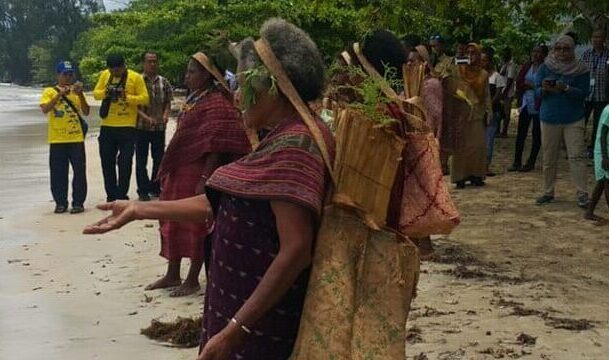
The sasi tradition reflects how indigenous communities in Maluku and Papua maintain a respectful relationship with nature. Practiced for centuries, this customary system temporarily restricts the harvesting of natural resources on land and at sea, allowing ecosystems to recover and regenerate. Enforced by community guardians known as kewang, sasi remains an effective community-based approach to sustainable natural resource management.
The ritual marking the opening of sasi and the start of seafood harvesting is led by a kewang, a community guardian. Source: Wikipedia
One of the best-known examples is the Sasi Lompa tradition in Haruku Village, Central Maluku. During designated closure periods, community members are prohibited from harvesting certain terrestrial and marine resources. These may include nutmeg and coconuts on land, as well as octopus, sea cucumbers, lobsters, and other marine species. Through this practice, local communities have demonstrated that traditional knowledge can contribute to the long-term sustainability of natural resources.
Menyanggar: Honoring Nature Before Opening New Land
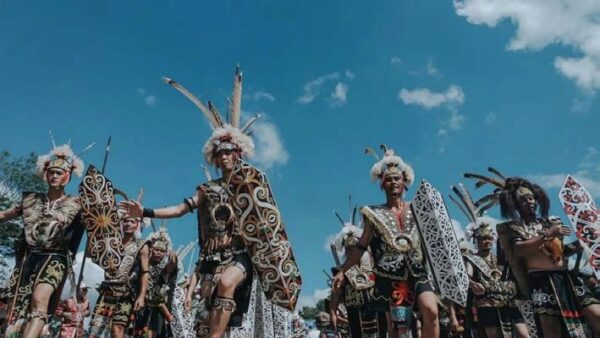
Among Dayak communities in Kalimantan, menyanggar is a traditional ritual performed before clearing land for agriculture or settlement. Led by a spiritual leader known as a mantir, the ceremony reflects the belief that humans should live in harmony with nature and carefully consider the environmental impacts of land-use decisions.
A mantir leads the traditional Menyanggar ceremony before the Dayak community opens land for agriculture or settlement. Source: Visit Kalteng
The tradition is closely linked to local ecological knowledge, taking soil conditions, fertility, and natural cycles into account when managing agricultural land. It often involves rotational cultivation with extended fallow periods. This approach allows forests and soils to recover, supporting both sustainable livelihoods and ecosystem health.
The Baduy People: Guardians of a Balanced Way of Life
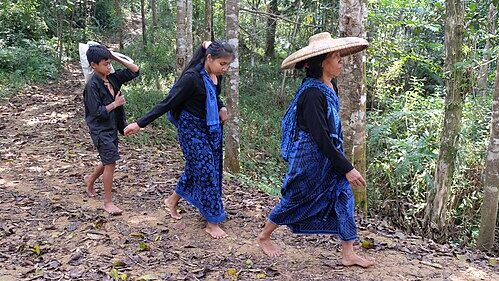
The Baduy people in Banten maintain a way of life that is deeply connected to nature and emphasizes living in balance with the environment. These reflected in their daily practices such as limiting tree harvesting, minimizing the use of modern technology, and avoiding synthetic agricultural chemicals. Agricultural activities are guided by a strong understanding of natural cycles, soil fertility, and land rotation. These principles help preserve the natural resources upon which their communities depend.
Members of the Outer Baduy community participate in a cultural activity that reflects their traditional way of life and connection to nature. Source: Wikipedia
The Baduy community manages its landscape through a traditional zoning system that defines the use of different areas. The reuma zone serves as a settlement area; the heuma zone is designated for farming and cultivation, and the leuweung kolot zone consists of protected old-growth forests. This zoning system helps ensure that natural resources are utilized responsibly
Ammatoa Kajang: Conserving Forests Through Simplicity and Tradition
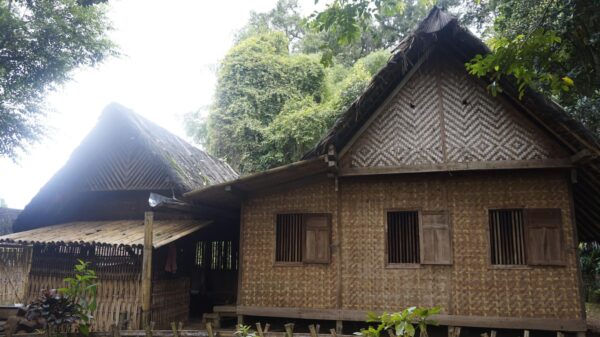
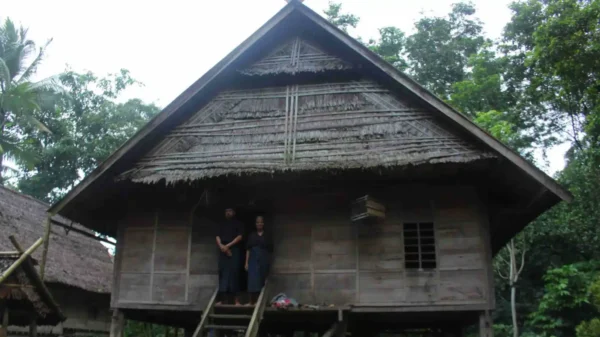
The Ammatoa Kajang community in Bulukumba, South Sulawesi, embraces a philosophy of simplicity, moderation, and harmony with nature. Reflected in their traditional black clothing, barefoot lifestyle, and limited use of modern technology, these practices symbolize humility, equality before the creator, and respect for ancestral values.
For the Ammatoa Kajang people, black clothing represents strength and equal status of all individuals before the creator. This worldview also encourages responsible resource use and helps prevent unnecessary exploitation of nature.
Traditional Ammatoa Kajang houses and community members wearing their characteristic black clothing, reflecting values of simplicity, equality, and respect for ancestral traditions. Source: Disparpora Bulukumba
The community protects its customary forest through a traditional zoning system. The borong karamaka (sacred forest) is strictly protected from resource extraction, while the borong batasayya (boundary forest) may be used under community-approved conditions. Trees harvested from this area must be replanted, helping preserve forest cover, biodiversity, and natural resources for future generations.
Subak: Community-Based Water Management in Bali
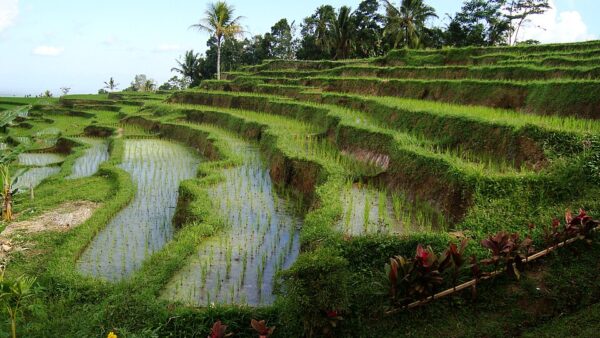
Originating in Bali, the subak system was recognized by UNESCO in 2012 as part of the island’s cultural heritage. Beyond an irrigation network, subak is a community-based organization that manages water distribution, especially rice cultivation. Through collective decision-making, farmers coordinate planting schedules, ensure fair water allocation, maintain irrigation infrastructure, and resolve conflicts related to water use.
Bali’s iconic terraced rice fields, managed through the community-based Subak irrigation system that promotes sustainable water use. Source: Wikipedia
Embracing the philosophy of Tri Hita Karana, subak emphasizes harmony among three relationships: the relationship between humans and God, among people, and between humans and nature. This philosophy guides not only agricultural practices but also community life, fostering a balanced approach to environmental stewardship and social cooperation. Subak is also closely linked to the worship of Dewi Sri, the goddess of rice and fertility in Balinese culture.
Trees4Trees and the Protection of Indonesia’s Cultural Landscapes
As environmental challenges become increasingly complex, the local wisdom practiced by indigenous peoples and traditional communities across Indonesia reminds us that protecting nature does not rely solely on modern technology, regulations, or scientific approaches, but also demonstrate practice of living in harmony with nature, using resources responsibly, and considering the well-being of future generations.
Trees4Trees recognizes that forests and trees are deeply intertwined with the cultural identity of local communities. Across its planting areas, it supports conservation initiatives that reinforce traditional knowledge and cultural heritage. In Bali, more than 17,000 trees have been planted since 2024 to support subak. In Kampung Laut, Central Java, our mangrove restoration efforts support local livelihoods and help sustain cultural practices, including mangrove natural dyed batik production.
Similarly, in West Java, Trees4Trees has planted more than 12 million trees throughout the Citarum Watershed, a landscape rich in cultural heritage and traditional communities, including those living around the Cikondang indigenous forest. Through these efforts, tree planting becomes not only an environmental intervention but also a means of preserving the cultural values that connect local people to their land.
As the world continues to seek sustainable solutions, local wisdom should not be viewed merely as a relic of the past, but as a valuable source of knowledge and inspiration. By learning from and supporting these traditions, we can strengthen efforts to build a more sustainable future, one that respects both people and the environment.
Writer: Muhammad Dimas. Editor: V. Arnila Wulandani. Photo: Wikipedia, Visit Klateng, Diasparpora Bulukumba, Kemas Duga Muis for Trees4Trees
Get news, updates, & event info delivered right to your inbox :
*By completing this form you are are signing up to receive our emails and can unsubscribe at any time.
Get the latest updates on our tree-planting journey – sent directly to your inbox.
By completing this form, you agree to receive our emails. You can unsubscribe at any time.
Subscribe Now
Get the latest updates on our tree-planting journey – sent directly to your inbox.
By completing this form, you agree to receive our emails. You can unsubscribe at any time.
We use information collected through cookies and similar technologies to improve your experience on our site, analyse how you use it and for marketing purposes.
We and our partners use information collected through cookies and similar technologies to improve your experience on our site, analyse how you use it and for marketing purposes. Because we respect your right to privacy, you can choose not to allow some types of cookies. However, blocking some types of cookies may impact your experience of the site and the services we are able to offer. In some cases, data obtained from cookies is shared with third parties for analytics or marketing reasons. You can exercise your right to opt-out of that sharing at any time by disabling cookies.
These cookies and scripts are necessary for the website to function and cannot be switched off. They are usually only set in response to actions made by you which amount to a request for services, suchas setting your privacy preferences, logging in or filling in forms. You can set your browser to block oralert you about these cookies, but some parts of the site will not then work. These cookies do not store any personally identifiable information.
Analytics
These cookies and scripts allow us to count visits and traffic sources, so we can measure and improve the performance of our site. They help us know which pages are the most and least popular and see how visitors move around the site. All information these cookies collect is aggregated and therefore anonymous. If you do not allow these cookies and scripts, we will not know when you have visited our site.
Embedded Videos
These cookies and scripts may be set through our site by external video hosting services likeYouTube or Vimeo. They may be used to deliver video content on our website. It’s possible for the video provider to build a profile of your interests and show you relevant adverts on this or other websites. They do not store directly personal information, but are based on uniquely identifying your browser and internet device. If you do not allow these cookies or scripts it is possible that embedded video will not function as expected.
Google Fonts
Google Fonts is a font embedding service library. Google Fonts are stored on Google's CDN. The Google Fonts API is designed to limit the collection, storage, and use of end-user data to only what is needed to serve fonts efficiently. Use of Google Fonts API is unauthenticated. No cookies are sent by website visitors to the Google Fonts API. Requests to the Google Fonts API are made to resource-specific domains, such as fonts.googleapis.com or fonts.gstatic.com. This means your font requests are separate from and don't contain any credentials you send to google.com while using other Google services that are authenticated, such as Gmail.
Marketing
These cookies and scripts may be set through our site by our advertising partners. They may be used by those companies to build a profile of your interests and show you relevant adverts on other sites. They do not store directly personal information, but are based on uniquely identifying your browser and internet device. If you do not allow these cookies and scripts, you will experience less targeted advertising.